Robert Noyce Biography--Robert Noyce's Full Life Info and Pics


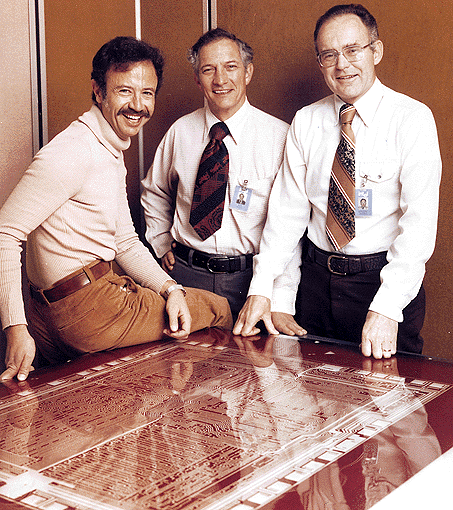
Robert Norton Noyce (December 12, 1927 – June 3, 1990), nicknamed "the Mayor of Silicon Valley", co-founded Fairchild Semiconductor in 1957 and Intel in 1968. He is also credited (along with Jack Kilby) with theinvention of the integrated circuit or microchip which fueled the personal computer revolution and gave Silicon Valley its name. Noyce was also a mentor and father-figure to an entire generation of entrepreneurs.

Biography

Early life and ancestors

He was born on December 12, 1927, in Burlington, Iowa. He was the third of four sons of the Rev. Ralph Brewster Noyce. His father was a 1915 graduate of Doane College, a 1920 graduate of Oberlin College, and a 1923 graduate ofChicago Theological Seminary. He was a Congregationalclergyman and the associate superintendent of the Iowa Conference of Congregational Churches in the 1930s and 1940s. His mother, Harriet May Norton, a 1921 graduate of Oberlin College, was the daughter of the Rev. Milton J. Norton, a Congregational clergyman, and Louise Hill. She has been described as an intelligent woman with a commanding will.
His earliest childhood memory involves beating his father at ping pong and feeling absolutely devastated when his mother's reaction to this thrilling news was a distracted "Wasn't that nice of Daddy to let you win?" Even at the age of five, Noyce was offended by the notion of intentionally losing at anything. "That's not the game," he sulked to his mother. "If you're going to play, play to win!"
In the summer of 1940, when he was 12, he built a boy-sized aircraft with his brother, which they used to fly from the roof of the Grinnell College stables. Later he built a radio from scratch and motorized his sled by welding a propeller and an engine from an old washing machine to the back of it.[

Education

He grew up in Grinnell, Iowa and attended the local schools. He exhibited a talent for math and science while in high school and took the Grinnell College freshman physics course in his senior year. He graduated from Grinnell High School in 1945 and entered Grinnell College in the fall of that year. He graduated Phi Beta Kappa with a BA in physics and mathematics from Grinnell College in 1949. He also received a signal honor from his classmates: the Brown Derby Prize, which recognized "the senior man who earned the best grades with the least amount of work". He received his Ph.D. in physics from Massachusetts Institute of Technology in 1953. He studied the first transistors, developed at Bell Laboratories, in a Grinnell College classroom.
While an undergraduate, Noyce attended a physics course of the professor Grant Gale and was fascinated by the physics. Gale got hold of two of the very first transistors ever to come out of Bell Labs and showed them off to his class and Noyce was hooked. Grant Gale suggested that he apply to the doctoral program in physics at MIT which he did. He had a mind so quick that his graduate school friends called him "Rapid Robert".
Family
He married Elizabeth Bottomley in 1953 and divorced in 1974. They had four children together. On November 27, 1974 Noyce married Ann Schmeltz Bowers. Bowers was the first Director of Personnel for Intel Corporation and the first Vice President of Human Resources for Apple Inc. She now serves as Chair of the Board and the founding trustee of the Noyce Foundation. Active all his life, Noyce enjoyed reading Hemingway, flying his own airplane, hang gliding, and scuba diving.
He believed that microelectronics would continue to advance in complexity and sophistication well beyond its current state, leading to the question of what use society would make of the technology.
Noyce died from a heart attack at home on June 3, 1990 at the Seton Medical Center in Austin, Texas.
At the time of his death, he was the president and chief executive officer of Sematech Inc., a non-profit consortium that performs basic research into semiconductor manufacturing. It was organized as a partnership between the United States government and 14 corporations in an attempt to help the American computer industry catch up with the Japanese in semiconductor manufacturing technology.

Awards and honors

In July, 1959, he filed for U.S. Patent 2,981,877 "Semiconductor Device and Lead Structure", a type of integrated circuit. This independent effort was recorded only a few months after the key findings of inventor Jack Kilby. For his co-invention of the integrated circuit and its world-transforming impact, three presidents of the United States honored him.
Noyce was a holder of many honors and awards. President Ronald Reagan awarded him the National Medal of Technology in 1987. Two years later, George H.W. Bush inducted him into the Business Hall of Fame. President George H. W. Bush presented the award, sponsored by the National Academy of Engineering, in a black-tie ceremony held at the State Department. In 1990 also Noyce—along with Jack Kilby, transistor inventor John Bardeen, and some other celebrities, received a "Lifetime Achievement Medal" during the bicentennial celebration of the Patent Act.
Noyce received the Franklin Institute’s Stuart Ballantine Medal in 1966. He was awarded the IEEE Medal of Honor in 1978 "for his contributions to the silicon integrated circuit, a cornerstone of modern electronics." In 1979, he was awarded the National Medal of Science. Noyce was elected a Fellow of the American Academy of Arts and Sciences in 1980.The National Academy of Engineering awarded him its 1989 Charles Stark Draper Prize.
Mr. Noyce was inducted into the Junior Achievement U.S. Business Hall of Fame in 1989. The science building at his alma mater, Grinnell College, is named after him..

Legacy

The Noyce Foundation was founded in 1991 by his family. The foundation is dedicated to improving public education in mathematics and science in grades K-12.
Source;; Wikipedia


Robert Noyce Google Doodle From Google Today--Robert Royce's 84th Birtday


Robert Noyce Google Doodle arrives on December 12, celebrates Robert Noyce’s life and Silicon Valley’s success.

After Diego Rivera’s Google Doodle last Thursday, Google’s patented Doodle is back on the homepage to celebrate what would have been the 84th birthday of Silicon Valley icon Robert Noyce, one of the founders of Intel Corporation, and one of the talented individuals behind the microchip which fueled PC revolution in California and gave the Silicon Valley its name.
The Doodle is not yet available here in United States, but our writers based in Hong Kong sent this image, saying that the Robert Noyce Google Doodle is now up and running in the Asia-Pacific. It is worth noting Hong Kong is 13 hours ahead of New York City, so the date there is already December 12, the birth date of Robert Noyce.
Robert Noyce Google Doodle
And to celebrate his birthday, Google tweaked its logo to feature a microchip with the Google branding. Apparently, Google is the company behind the open platform Android, so it looks like the search engine giant has the reason to celebrate the microchip (or CPU), and celebrating Robert Noyce’s birthday is like thanking him too.
According to Mr. Noyce’s Wikipedia entry, he was born and raised in Iowa. At the age of 12, he created his first boy-sized aircraft, and assembled a radio from scratch. He graduated from Grinnell High School in 1945 and entered Grinnell College in the fall of that year. He graduated there with a BA in physics and mathematics and in 1953, he earned his Ph.D. in physics from Massachusetts Institute of Technology.
After his graduation, his first job was a research engineer at the Philco Corporation in Pennsylvania and left the company in 1956 and moved to Mountain View, California to work at Shockley Semiconductor Laboratory. After one year with William Shockley, he co-founded Fairchild Semiconductor corporation.
After 10 years with Fairchild, he and Gordon Moore founded Intel in 1968.
Now let’s talk Mr. Noyce’s his love life. According to his Wiki entry, he married Elizabeth Bottomley in 1953 but they divorced in 1974. Noyce and Bottomley had four children.
After his divorce, Noyce married Ann Schmeltz Bowers, the first Director of Personnel for Intel Corporation and the first Vice President of Human Resources for Apple Inc.
Noyce died from a heart attack at home on June 3, 1990 in Texas.
To honor the memory and Dr. Robert N. Noyce, his family founded Noyce Foundation in 1990 “to support the informal science community to develop work that addresses the gaps that exist in outcomes measurement, research and evaluation, program scale up, leadership development, policy issues, and pathways or pipeline design.”


Zulfiqar Ali Bhutto (9th P.Minister of Pakistan)


Biography(5 January 1928 – 4 April 1979);
Zulfiqar Ali Bhutto was born on January 5, 1928. He was the only son of Sir Shah Nawaz Bhutto. Zulfiqar Ali Bhutto completed his early education from Bombay's Cathedral High School. In 1947, he joined the University of Southern California, and later the University of California at Berkeley in June 1949. After completing his degree with honors in Political Science at Berkeley in June 1950, he was admitted to Oxford.
Zulfiqar Ali Bhutto married Nusrat Isphahani on September 8, 1951. He was called to Bar at Lincoln's Inn in 1953, and the same year his first child, Benazir Bhutto, was born on June 21. On his return to Pakistan, Bhutto started practicing Law at Dingomal's.
In 1958, he joined President Iskander Mirza's Cabinet as Commerce Minister. He was the youngest Minister in Ayub Khans Cabinet. In 1963, he took over the post of Foreign Minister from Muhammad Ali Bogra.
His first major achievement was to conclude the Sino-Pakistan boundary agreement on March 2, 1963. In mid 1964, Bhutto helped convince Ayub of the wisdom of establishing closer economic and diplomatic links with Turkey and Iran. The trio later on formed the R. C. D. In June 1966, Bhutto left Ayub's Cabinet over differences concerning the Tashkent Agreement.
Zulfiqar Ali Bhutto launched Pakistan Peoples Party after leaving Ayub's Cabinet. In the general elections held in December 1970, P. P. P. won a large majority in West Pakistan but failed to reach an agreement with Sheikh Mujib-ur-Rahman, the majority winner from East Pakistan. Following the 1971 War and the separation of East Pakistan, Yahya Khan resigned and Bhutto took over as President and Chief Martial Law Administrator on December 20, 1971.
In early 1972, Bhutto nationalized ten categories of major industries, and withdrew Pakistan from the Commonwealth of Nations and S. E. A. T. O. when Britain and other western countries recognized the new state of Bangladesh. On March 1, he introduced land reforms, and on July 2, 1972, signed the Simla Agreement with India, which paved the way for the return of occupied lands and the release of Pakistani prisoners captured in East Pakistan in the 1971 war.
After the National Assembly passed the 1973 Constitution, Bhutto was sworn-in as the Prime Minister of the country.
On December 30, 1973, Bhutto laid the foundation of Pakistan's first steel mill at Pipri, near Karachi. On January 1, 1974, Bhutto nationalized all banks. On February 22, 1974, the second Islamic Summit was inaugurated in Lahore. Heads of States of most of the 38 Islamic countries attended the Summit.
Following a political crisis in the country, Bhutto was imprisoned by General Zia-ul-Haq, who imposed Martial Law on July 5, 1977.
On April 4, 1979, the former Prime Minister was hanged, after the Supreme Court upheld the death sentence passed by the Lahore High Court. The High Court had given him the death sentence on charges of murder of the father of a dissident P. P. P. politician.
Zulfiqar Ali Bhutto was buried in his ancestral village at Garhi Khuda Baksh, next to his father's grave.
1928-79 | Zulfikar Ali Bhutto; Complete Profile.....Chairman & Founder Pakistan Peoples Party
PERSONAL DETAILS

  • Name Zulfikar Ali Bhutto
  • Date of Birth January 5, 1928
  • Place of Birth Larkana District
  • Father's Name Sir Shahnawaz Khan Bhutto
  • Mother's Name Lady Khursheed Begum
  • Mother Tongue Sindhi
MARRIAGE:
  • Married at Karachi to Ms Nusrat Ispahani September 8, 1951
CHILDREN:
  • Benazir Bhutto - 1953 - 2007
  • Murtaza Bhutto - 1954 - 1996
  • Sanam Bhutto - 1957
  • Shahnawaz Bhutto - 1958 - 1985
EDUCATION
  • Cathedral School, Bombay - 1937 - 1947
  • Joined University of Southern California - 1947
  • Transferred to Berkely Campus of USC - 1949
  • First Asian to be elected to Berkely Student Council
  • Graduated with Honours in Political Science - 1950
  • Admitted to Christ Church College, Oxford - 1950
  • Graduated with Honours from Oxford University - 1952
  • Called to the Bar at Lincoln's Inn - 1953
  • Lecturer of Sindh Muslim Law College – 1954
  • Member of Pakistan Delegation to the United Nations - 1957
  • Addressed the United Nations Sixth Committee on Aggression - October 25, 1957
  • Leader of Pakistan Delegation to United Nations Conference on the Law of the Seas, addressed the Conference on the Freedom of the Seas.- March - 1958
MINISTERIAL CAREER
  • Minister of Commerce - 1958
  • Minister for Information and National Reconstruction - 1959
  • Minister for Fuel, Power and Natural Resources - 1960
  • Leader of Pakistan Delegation to the UN - 1959, 1960, 1963 & 1965
  • Statement in support of Algeria against French Imperialism at UN - 1959
  • Leader of Pakistan Delegation to Moscow to negotiate agreement on Oil and Gas Exploration with Soviet Union with 120 Million Roubles credit - 1960
  • Led Pakistan's Delegation to UN and differed with US by not voting against China's Membership - 1960
  • Foreign Minister of Pakistan - 1963 – 1965
  • Sino-Pakistan Boundary Agreement, gaining 750 Square Miles for Pakistan 2nd March - 1963
  • Famous Speech at the U.N. Security Council "We will wage a war for a thousand years" - 22-23 September 1965
  • Resigned from the Federal Cabinet - June, 1966
PAKISTAN PEOPLES PARTY (PPP)
  • Historic welcome in Lahore after resignation as Foreign Minister - 21st June, 1966
  • Manifesto of Pakistan Peoples Party prepared
  • "Islam is our Faith, Democracy is our Policy, Socialism is our Economy, All Power to the People". October, 1966
  • Foundation of Pakistan Peoples Party, Lahore - 30th November, 1967
  • Led Mass Movement for Restoration of Democracy - 1968
  • Arrested for creating disaffection against Government-November 12, 1968
  • Landslide victory for PPP in 1970 elections in present day Pakistan - December 7, 1970
PRESIDENT/PRIME MINISTER
  • Economic Reforms Order Nationalisation of Key Industries - January 3, 1972
  • Announcement of Labour Policies - February 10, 1972
  • Workers would participate in Profits
  • Old Age Pensions and Group Insurance
  • Land Reforms - 1st March, 1973
  • Ceiling reduced from 500 Acres to 150 Acres of irrigated land and 1000 Acres to 300 Acres for semi-irrigated land. All lands in excess of 100 Acres allocated to Govt. Servants confiscated and redistributed.
  • The Law Reform Ordinance - giving effect to the recommendations of the Law Reforms Commission. - 14th April, 1972
  • Martial Law Lifted 21st April, 1972
  • Simla Agreement Signed
  • Pakistan to get back 5000 square miles of territory occupied in 1971 war. India and Pakistan to respect line of control in Kashmir without prejudice to Pakistan's claim. - 2nd July, 1972
  • National Book Foundation established - 24th September, 1972
  • Inaugurated Pakistan's first Nuclear Power Plant at Karachi. - 28th November, 1972
  • Establishment of NDFC - 5th February, 1973
  • Establishment of Quaid-E-Azam University - 9th February, 1973
  • Constitution of Pakistan passed unanimously - 12th April, 1973
  • Establishment of Port Qasim Authority - 27th June, 1973
  • Elected Prime Minister of Pakistan - 14th August, 1973
  • Identity Cards for Citizens - 28th July, 1973
  • Agreement for repatriation of 93,000 POWs - 28th August, 1973
  • Administrative Reforms Order - September, 1973
  • Laid Foundation Stone of Pakistan Steel Mill - 30th December, 1973
  • Nationalisation of Banks - 1st January, 1974
  • Establishment of Allama Iqbal Open University - 21st May, 1974
  • Islamic Summit at Lahore - 22nd February, 1975
  • Inaugurated Pakistan's First Seerat Conference - 3rd March, 1976
  • Kissinger warned Zulfikar Ali Bhutto that if Pakistan continued with its nuclear programme "the Prime Minister would have to pay a heavy price." - August, 1976
  • Bhutto proposed a Third World Summit - September, 1976
BETRAYAL AND ASSASSINATION

  • General Elections were held on March 7, 1977. PPP emerged as the victorious Party. At the behest of General Ziaul Haq, PNA accused government of so-called rigging in the elections. Negotiations with PNA resumed. An Agreement was reached on June 8, 1977 for holding Fresh Elections on October 8, 1977.
  • On July 5, 1977 COAS General Ziaul Haq imposed Martial Law unilaterally. The National Assembly, the Senate and Provincial Assemblies were dissolved and Constitution held in abeyance.
  • Zia's Military Junta established a dummy government of PNA with CMLA as President. Zulfikar Ali Bhutto arrested on July, 5, 1977 and released on July 28, 1977.
  • Re-arrested on September 3, 1977 from Clifton, Karachi, on the charges of a fabricated murder case; again released on September 13, 1977 against Lahore High Court bail. Re-arrested at Larkana on September 17, 1977.
  • On September, 1977 the Chief Justice of Pakistan, Mr. Justice Yakub Ali Khan was suspended from service because he had admitted Mrs. Nusrat Bhuto's Petition challenging imposition of martial law.
  • On October 9, 1977, Maulvi Mushtaq, Chief Justice, Lahore High Court, cancelled the bail already granted to Zulfikar Ali Bhutto by LHC.
  • Mercilessly and despicably murdered on April 4, 1979. 
Zulfikar Ali Bhutto as 'Author'...List of Publication
  • Peace-Keeping by the United Nations. Pakistan Publishing House, Karachi. - 1967
  • Political Situation in Pakistan, Veshasher Prakashan, New Dehli. – 1968
  • The Myth of Independence, Oxford University Press, Karachi and Lahore. - 1969
  • The Great Tragedy, Pakistan People's Party, Karachi. - 1971
  • Politics of the People (speeches, statements and articles), edited by Hamid Jalal and Khalid Hasan: Pakistan Publications, Rawalpindi. - 1948-1971
  • Speeches and Statements, Government of Pakistan, Karachi. - 1971-75
  • Bilateralism: New Directions. Government of Pakistan, Islamabad - 1976
  • The Third World: New Directions. Quartet Books, London. - 1977
  • My Pakistan. Biswin Sadi Publications, New Dehli. - 1979
  • If I am Assassinated, Vikas, New Dehli. - 1979
  • My Execution. Musawaat Weekly International, London - 1980
  • New Directions. Narmara Publishers, London. - 1980
THE LEGACY OF ZULFIKAR ALI BHUTTO....
As a member of Pakistan's delegation to the United Nation in 1957, at the age of 29 years, Zulfikar Ali Bhutto addressed the Sixth Conference of the United Nations on "The Definition of Aggression", a speech which is still regarded as one of the best on the subject. As a participant at the International Conference in Geneva, Switzerland in March, 1958 Zulfikar Ali Bhutto spoke for mankind with the bold declaration: "The High Seas are free to all." He was the youngest Federal Cabinet member in the history of Pakistan, at the age of 30. Zulfikar Ali Bhutto held the key portfolios of Minister of Commerce, Minister of Information, Minister of National Reconstruction, Minister of Fuel, Power and Natural Resources before becoming the Foreign Minister. As Minister of Fuel, Power and Natural Resources, he signed a path breaking agreement for exploration of oil and gas with Russia in 1960. He set up a Gas and Mineral Development Corporation in 1961 and Pakistan's first refinery in 1962 at Karachi.
Bhutto emerged on the world stage as Leader of the Pakistan Delegation to the UN in 1959. To muster the support for Kashmir issue he successfully toured China, Britain, Egypt and Ireland. He also held a series of talks with the Indian Foreign Minister Swaran Singh. He was appointed Foreign Minister in 1963 and remained at that post until his resignation in June 1966. Bhutto made indelible imprints on world community by his inimitable oratorical skills in United Nation's General Assembly and the Security Council. He had the vision to build a strategic relationship with China at a time when it was isolated. Zulfikar Ali Bhutto believed in an independent Foreign Policy which had hitherto been the hand maiden of the Western Powers. During his tenure as Foreign Minister, Pakistan and Iran cemented a special relationship. His opposition to the Tashkent accord between India and Pakistan led to his resignation from the government. Zulfikar Ali Bhutto believed in a Foreign Policy of bilateralism in which no state would be entitled to interfere in Pakistan's relations with other states.
During his student days, Zulfikar Ali Bhutto had acquired an anti-Imperialist view of the world. He was a firm believer in economic self reliance and political independence themes he expounded in his famous book "Myth of Independence". Bhutto's finest hour came in the reconstruction of Pakistan after the traumatic dismemberment of Pakistan upon the fall of Dhaka on 16th December, 1971. He successfully put the derailed nation back on the track by rebuilding national institutions. His lasting achievement was the unanimous adoption of the Constitution in 1973. He established the Pakistan Steel Mills, Heavy Mechanical Complex Taxila, Port Qasim Authority, Quaid-e-Azam University, Allama Iqbal Open University, Karachi Nuclear Power Plant; thus, fortifying the prosperity, integrity and security of Pakistan. Using his experience as Foreign Minister, Bhutto cemented Pakistan's relation with Afro-Asian and Islamic countries and by 1976 had emerged as the Leader of the Third World. As an author, he brilliantly advocated the cause of hewers of wood and drawers of water of the Third World.
Bhutto was the founder of Pakistan's Nuclear Program. Under his guidance and leadership as Minister for Fuel, Power and Natural Resources, President and Prime Minister, Pakistan developed into the unique Muslim State with a nuclear capability for which he paid with his life. In his book "If I am Assassinated" written from the Death Cell, Zulfikar Ali Bhutto revealed how Kissinger had said "We will make an example of you".
The Pakistan People's Party won the elections held in 1977 with a large majority; but the conspirators soon joined hands with Ziaul Haq at the behest of foreign powers who feared Bhutto's capacity of uniting the Third World countries and sought to punish him for developing Pakistan's nuclear capacity, and imposed Martial Law upon the country on 5th July, 1977. Soon afterwards, Bhutto was arrested and on 18th March, 1978, was sentenced to death in a politically motivated murder trial. The majority of original Court was for acquittal but was whittled down to a 4-3 verdict by the retirement of two judges. Despite appeals of clemency from several world leaders, Bhutto was executed on 4th April, 1979. The great leader of downtrodden masses and a visionary of unparalleled charisma will forever be remembered by his countrymen as Quaid-e-Awam (Leader of the Masses).
RESUME
Zulfikar Ali Bhutto has earned a place in the pantheon of leaders from the Third World who earned everlasting fame in the struggle against colonialism and imperialism. He had the privilege of interacting with many of those leaders who played a great role in the epic struggle for national independence in the 20th Century including Mao Tse Tung, Ahmed Soekarno, Chou-en Lai, Jawaharlal Nehru Gamal Abdel Nasser and Salvador Allende. During the period between the end of the Second World War and the end of the Cold War, the world was divided into two blocks: The Capitalist West and the Socialist East. All these leaders aspired to aspects of a socialist pattern of economy. Bhutto shared their faith in a leading role for the public sector as an instrument of self-reliance.
President of Allende of Chile and Zulfikar Ali Bhutto of Pakistan pursued socialist democratic policies in countries long dominated by the military, and thus, were overthrown in the same year - 1977 by the collaborators of the Neo-Imperialists, killed at the behest of the Military Juntas of Pinochet and Zia and followed by long spells of repressive Military regimes which did not retreat until the Cold War drew to an end.
The key factor in the over throw of Bhutto was Pakistan's nuclear capability. The Karachi Nuclear Power Plant was inaugurated by Zulfikar Ali Bhutto as President of Pakistan at the end of 1972 but long before, as Minister for Fuel, Power and National Resources, he has played a key role in setting up of the Pakistan Atomic Energy Commission. The Kahuta facility was also established by Bhutto.
Bhutto's foundation of the PPP was a setback for the reactionary forces in a country long dominated by the Right. The slogan of "Food, Shelter and Clothing" shifted the focus of Pakistan politics from theological to economic issues. This focus has never shifted back. Bhutto nationalised the commanding heights of the economy; another blow to the capitalist West. During his tenure there was a massive transfer of resources towards the dominant rural economy by setting higher prices for agricultural products.
The Constitution of 1973, passed unanimously, is yet another lasting legacy of Zulfikar Ali Bhutto. Time has shown that it cannot be replaced. Constitution making in Pakistan was bedevilled, since the birth of the State, by three unresolved issues: (i) The role of Islam in the State, (ii) the degree of Provincial Autonomy, and (iii) the Nature of Executive. Bhutto managed to bring all the political parties, including those like the Jamat-e-Islami, JUI and JUP, who demanded an Islamic State, and the Awami National Party, which was the major party in the Frontier and Balochistan, calling for maximum provincial autonomy, to agree to a consensus on the Constitution, thus, permanently resolving all the three issues. A new institution, the Senate of Pakistan was, created in which the provinces had equal representation, in order to redress the balance of power in Pakistan, probably the only country in the world where one federating unit has an absolute majority. The creation of Council of Common Interest also gave to the provinces a greater weight in the federal dispensation. Islam was declared to be the State religion and the Council of Islamic Ideology given charge of Islamisation of laws. At the same time the Constitution reiterated the basic principle of socialism: "from each according to his ability to each according to his work".
The never ending tussle between the Head of State and Parliament was resolved by empowering the Prime Minister. Ironically, it is opponents of Bhutto who have, through 13th Amendment of 1997, restored the role of the Prime Minister as was envisaged in the original Constitution of 1973 after General Zia had shifted power to dissolve the Assembly and make key civilian and military appointments to the President No better tribute can be paid to the foresight and sagacity of the martyred leader.
Finally, Zulfikar Ali Bhutto had the courage of his conviction to decide to lay down his life rather than compromise or seek appeasement. The last chapter of his life is a glorious example of martyrdom for the cause of resurrection of democracy. 

At the time of his overthrow, Bhutto was emerging as a spokesman of the World of Islam and the leader of the Third World. The age of Bhutto was an Age of Revolution. Although his life and career were cruelly terminated, Zulfikar Ali Bhutto will forever shine in history as one of the Great leaders who took part in the liberation of the Third World from the yoke of Imperialism and Neo Colonialism during the Twentieth Century.


Begum Nusrat Bhutto (1929--Oct 2011) Biography


Begum Nusrat Bhutto was born on 23rd March 1929, former first lady of Pakistan, widow of Shaheed Zulfikar Ali Bhutto and mother of Pakistan People's Party (PPP) Chairperson Mohtarma Benazir Bhutto, who was also a former Prime Minister of Pakistan.
Nusrat Ispahani is a Iranian from Kurdistan Province, Iran by heritage and daughter of a wealthy Iranian businessman who settled in Karachi, British India before its partition. Nusrat met Zulfikar Ali Bhutto in Karachi where they got married. That was to be Zulfikar Ali Bhutto's 2nd marriage.
As first lady from 1973-1977, Nusrat Bhutto functioned as a political hostess and accompanied her husband on a number of overseas visits. In 1979, after the trial and execution of her husband, she and her daughters were imprisoned and put under house arrest by the new regime of Zia-ul-Haq. However, due to health concerns she was later permitted to leave the country for London, where she was later joined by her daughters Benazir and Sanam. She became leader of the People's Party of Pakistan during her London exile and although she was chairman of the party for life, her daughter Benazir Bhutto later replaced her in the post.
After returning to Pakistan in the late 1980s, she served several terms as an MP to the National Assembly from the family constituency of Larkana in Sindh. Also, during the administrations of her daughter Benazir, she became a cabinet minister and Deputy Prime Minister.
She outlived three of her children Murtaza, Benazir and Shahnawaz Bhutto. Of the immediate family, only Sanam Bhutto, daughter of Nusrat and ZA Bhutto remains. She suffered from the combined effects of a stroke and Alzheimer's Disease. She passed away on October 23, 2011. Begum Nusrat Bhutto was 82 years old at the time of her death.

A Tribute to Begum Nusrat Bhutto
By Wajid Shamsul Hasan. March 24, 2007.

Unaware of what horrendous things are happening to Quaid and her martyred husband ZAB’s Pakistan, Begum Nusrat Bhutto’s (March 23 is her 78th birthday) gaze is stuck on the horizon. One cannot read her mind. Though she appears overly blank but her once beautiful mien still retaining its noble grace—is full of tales that catalogue not only her eventful and yet tragic life and a catalogue of crimes and follies of undemocratic rulers that have scarred the pristine face of her country.

March 23 is a landmark day in the life of Pakistani nation—if at all a people fractured and divided by its rulers—can still be described as a nation. It is, indeed, a historic coincidence that in the year 1929 on March 23 Isphanis of Karachi were gifted by Allah, the Most Generous, with a daughter—Nusrat Khanum—who was chosen by destiny to be the great woman behind a colossus of man that her husband Zulfikar Ali Bhutto grew to be.
An Iranian Kurd by origin tracing her ancestry to the legendary Islamic hero, statesman and a great soldier Salahuddin Ayubi—Nusrat Bhutto was surfeit with compassion, grit, dauntless determination and courage from the days of her childhood. And her dynamism, love and care for humanity blossomed her into a young lady who would strive, seek and not yield at a challenging time when loads and loads of trains packed with refugees from India were pouring into Karachi in the aftermath of partition of the sub-continent.
As a self-less member of the Women’s National Guard she rendered herself day and night into the relief operation of the millions of the uprooted refugees, feeding them, providing them shelter and succour when Karachi—nay entire Pakistan—had no resources, no infra-structure, no proper administrative set up, no houses, no medicare—for the teeming thousands except of course a generous and hospitable heart and determined relief operators like Nusrat Khanum. At that hour of crisis though physically frail, she stood tall among the tallest of ladies that had plunged themselves in one of the biggest relief work ever undertaken. She showed rare qualities of leadership and selfless service that inspired others and strengthened young nation’s will to survive despite the odds—a fact recognised and acknowledged by both Mohtarma Fatima Jinnah and Begum Liaquat Ali Khan. Quaid too was proud of such Herculean services that Nusrat Khanum and the like had left no stone unturned to render to the afflicted people. Looking at their gigantic performance he had remarked that no odds, no challenges, no difficulties could overawe a nation that had youth like Nusrat in the field.
Begum Nusrat Bhutto was born with a silver spoon in her mouth to a wealthy and culturally rich Iranian businessman whose ancestors had settled in Karachi and had a vast network of roaring business across the sub-continent at the time of partition. And being a lady of sterling qualities of both head and heart as she was, she found her match in Zulfikar Ali Bhutto in Karachi. It was love at first sight that landed them in a wed-lock and a marriage that lasted to ZAB’s martyrdom and her uncompromising devotion to him to this day.
Her marriage to ZAB was also a great turning point in his life. Though himself a highly qualified and richly endowed scion of an illustrious parentage and heritage, stability at home provided to him by Begum Nusrat Bhutto, enabled him to harness his energies and knowledge in the service of the nation onto pastures new to the last drop of his blood—a promise that he had made in writing to Pakistan’s founder the Quaid when he was still a student. While he made his mark as Pakistan’s representative to the UN as a young lawyer, his wife stood behind as a rock, through thick and thin, hell and high water—to see him travel rapidly in the realms of one success after the other. He was no doubt a great man in the making and the woman behind him was Begum Nusrat Bhutto.

When he became youngest member of Ayub Khan’s cabinet—a position that he held—handling successfully different important portfolios—until he resigned as Foreign Minister, his capable wife Begum Bhutto acquitted admirably well the responsibilities of bringing up their four children—Benazir, Murtaza, Sanam and Shahnawaz and also the role of playing a perfect hostess. She also lent support to her husband socially, looking after his swelling number of admirers and followers. Since good bearing was in their blood and top priority fixed for them by their father was acquisition of high quality education, it fell on the shoulders of Begum Bhutto to bring the children in such a manner that it should do Bhutto heritage a proud.
Despite the fact that as the wife of Pakistan’s most ever dynamic foreign minister she had to travel with him far and wide and play hostess at various functions by him, she did not allow any strain on her responsibilities as a perfect mother. Her total devotion in bringing up their children is perhaps the reason that all of their off-springs were highly educated.
The true strength and greatness of character—that she had in her blood by virtue of her ancestral lineage with the great Kurd—Salahuddin Ayubi—manifested itself when her husband broke away with President Ayub Khan for his surrendering to India at Tashkent followed by his resignation as foreign minister and formation of Pakistan’s People’s Party as harbinger of change and empowerment of the people. Once he was opposed to Ayub Khan, the military dictator unleashed the state hounds on him, incarcerated him and persecuted him to no ends. Begum Bhutto kept alighted the flame of her husband’s struggle for democracy and unshackling of the masses, braced to face the dictatorial batons, worst harassment and intimidations keeping the masses march onward until their victory.
Begum Bhutto, however, gave her best when Bhutto Sahib’s elected government was removed on July 5, 1977 by General Ziaul Haq’s coup in the dark of the night in the bleakest hour in the nation’s life. She not only lead the people and kept ignited their democratic aspirations when her husband was incarcerated facing a concocted murder charge. Though she was not alone this time as her equally talented and gifted daughter Benazir Bhutto was with her, she nominated by Bhutto Sahib as the party chairperson in his absence, kept the party flag high in defiance of a ruthless martial law and state oppression to the extent that she received a head injury in the baton charge by Zia’s thugs. And this head wound—having not allowed its proper and timely treatment-- had an ever lasting injurious effect on her to the extent that it has gradually disabled her. Despite that she has shown tremendous forbearance and tenacity. Assassination of her youngest son by Zia’s hired killers—Shahnawz Bhutto—did have a devastating effect on her followed by Murtaza Bhutto’s in the prime of his life. The head wound that did not overwhelm her not-withstanding constant persecution, character-assassination and life in exile, did finally lead to incurable consequences.
The revenge of the Pakistani people as manifested in the electoral victory of Pakistan People’s Party under her daughter Benazir Bhutto’s leadership in late 1988 and in 1993 despite the worst possible manipulations and rigging by the successive unrepresentative rulers and the highest number of votes PPP received in the overly flawed 2002 polls—are the fruits of the selfless devotion of Bhuttos to the people and the overwhelming confidence they enjoy among the masses.
Twice Begum Bhutto was elected member of the National Assembly, remained a senior minister and also a constant source of inspiration for her daughter former Prime Minister Benazir Bhutto, masses and PPP workers especially. She has done proud to the country by representing Pakistan at various international forums and her contribution as the Chairperson of the Red Crescent had gone a long way in improving the country’s image. She has also received various international awards for her immense contribution to the greatest good of the largest number especially workers, women and children.
Begum Nusrat Bhutto had always been a fighter. She fought the battle for the empowerment of the people in the streets against dictatorship. She fought for their rights in the apex courts. And even today she is fighting a battle with life under the constant care of her loving daughter Benazir Bhutto and her grand children so that she could see the fulfilment of the democratic dream of the Quaid and her martyred husband who walked to the gallows head high so that his people do not have to bow to oppression and dictatorship. May Allah, the Most Compassionate, give her strength and long life to see the end of the journey with the early return of democracy and blossoming of a civil society that ensures equality to all—irrespective of caste, creed or colour.


John James Audubon Biography


Born: 26-Apr-1785
Birthplace: Les Cayes, Santo Domingo, Haiti
Died: 27-Jan-1851
Location of death: Minnie's Land (Audubon Park), New York City
Cause of death: unspecified
Remains: Buried, Trinity Cemetery, Manhattan, NY
Gender: Male
Race or Ethnicity: Multiracial
Sexual orientation: Straight
Occupation: Naturalist, Artist
Nationality: United States
Executive summary: Illustrated Birds of America
The American naturalist John James Audubon was born on 26th April 1785 in Haiti, his father being a French naval officer and his mother a Spanish creole. He was educated in Paris, where he had lessons from the painter, J. L. David. Returning to America in 1798 he settled on a farm near Philadelphia, and gave himself up to the study of natural history, and especially to drawing birds. In 1826 he went to England in the hope of getting his drawings published, and by the following year he had obtained sufficient subscribers to enable him to begin the publication of his Birds of America, which on its completion in 1838 consisted of 435 colored plates, containing 1055 figures of birds the size of life.Georges Cuvier called it "le plus magnifique monument que l'art ait encore elevĂ©e a la nature." The descriptive matter to accompany the plates appeared at Edinburgh in 5 volumes from 1831 to 1839 under the title ofAmerican Ornithological Biography. During the publication of these works Audubon divided his time between Great Britain and America, devoting his leisure to expeditions to various parts of the United States and Canada for the purpose collecting new material. In 1842 he bought an estate on the Hudson, now Audubon Park in New York City. In 1844 he published in America a popular octavo edition of his Birds of America. He also took up the preparation of a new work, The Quadrupeds of America, with the collaboration of John Bachman, the publication of which was begun in New York in 1846 and finished in 1853-4. He died at New York on the 27th of January 1851.
Father: Jean Audubon (French sea merchant)
Mother: Jeanne Rabin (Creole mistress)
Wife: Lucy Bakewell (m. 1808, d. 19-Jun-1874)
Son: Victor Gifford Audubon (b. 6-Jun-1809)
Son: John Woodhouse Audubon (d. 21-Feb-1862)
    Royal Society of Edinburgh Fellow (1827)
    Kentucky Colonel
    Bankruptcy jailed (1819)
    French Ancestry Paternal
    Spanish Ancestry Maternal
    Creole Ancestry Maternal
Is the subject of books:
Audubon and His Journals1897BY: Maria R. Audubon
John James Audubon1964BY: Alice Ford
Author of books:
Birds of America (1838, nonfiction)
American Ornithological Biography (1831-9, nonfiction, 5 vols.)
The Quadrupeds of America (1853-4, nonfiction, with John Bachman)
Appears on postage stamps:
USA, Scott #1863 (22 cents, issued 23-Apr-1985)
USA, Scott #3650 (37 cents, depicting birds, issued 27-Jun-2002)


Yuri Gagarin Biography


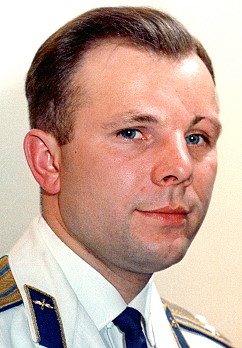
Yuri A. Gagarin was born on a collective farm in a region west of Moscow, Russia on March 9, 1934. His father was a carpenter. Yuri attended the local school for six years and continued his education at vocational and technical schools. Yuri Gagarin joined the Russian Air Force in 1955 and graduated with honors from the Soviet Air Force Academy in 1957. Soon afterward, he became a military fighter pilot. By 1959, he had been selected for cosmonaut training as part of the first group of USSR cosmonautsYuri Gagarin flew only one space mission. On April 12, 1961 he became the first human to orbit Earth. Major Yuri Gagarin's spacecraft, Vostok 1, circled Earth at a speed of 27,400 kilometers per hour. The flight lasted 108 minutes. At the highest point, Yuri Gagarin was about 327 kilometers above Earth.
Once in orbit, Yuri Gagarin had no control over his spacecraft. Vostok's reentry was controlled by a computer program sending radio commands to the space capsule. Although the controls were locked, a key had been placed in a sealed envelope in case an emergency situation made it necessary for Yuri Gagarin to take control. As was planned, Cosmonaut Yuri Gagarin ejected after reentry into Earth's atmosphere and landed by parachute.
Colonel Yuri Gagarin died on March 27, 1968 when the MiG-15 he was piloting crashed near Moscow. At the time of his death, Yuri Gagarin was in training for a second space mission.


VIDEO

RECENT POSTS

POPULAR POSTS


Pak India Zone Copyright © 2011 LKart Theme Powered by Blogger